By Tess A. Toland, Esq. May 19, 2026
An Ancient Roman town that has been sleeping by the Tyrrhenian Sea for thousands of years is waking. Seated just inland, in modern day Santa Marinella, Italy, the entrance to what was once a vibrant, coastal Roman town is now marked by a ground-mounted sign beside a busy road that reads: “Scavi di Castrum Novum”—Excavations of Castrum Novum.
Castrum Novum’s first structures were built in 264 B.C. to guard Rome against Carthage in the First Punic War. It functioned first as a military fortress and shielded Rome from Carthagenian threats by sea. Following Rome’s victory against Carthage, what began as a military outpost shifted into public and social structures. Castrum Novum developed into a seaside town that excavations have revealed contained a central road, homes, shops, burial grounds, government buildings, thermal baths, a theater, a fountain, and a small altar dedicated to Apollo.
The oldest cartographic record of Castrum Novum is found in the “Tabula Peutingeriana,” a map from the 4th century A.D.
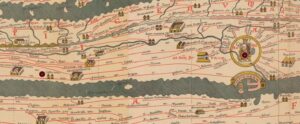
Tabula Peutingeriana (4th century A.D.)
PHOTO CASTRUM NOVUM ARCGIS STORYMAP BY KLÁRA PREUSZ, MICHAL PREUSZ, AND FLAVIO ENEI (2023)
The first excavations of Castrum Novum began in 1776 and were conducted under papal authority, led by the Reverend of the Apostolic Chamber. Sculptures discovered at Castrum Novum in the 18th century, including a statue of Bacchus and a herm depicting Aspasia, are displayed today in the Vatican Museums. The 18th century archaeologists conducted 4 survey campaigns, the last of which took place in 1794.
For a few hundred years, the site was once again forgotten, overgrown, even used as grazing land for livestock, until a systematic investigation of Castrum Novum began in 2010, spearheaded by the Museo del Mare e della Navigazione Antica in Santa Severa, which has partnered with the French universities of Lille and Amiens and the Gruppo Archeologico del Territorio Cerite (GATC) to bring this ancient town’s yet-to-be-discovered marvels to light.
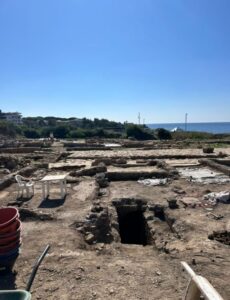
View from North side of Castrum Novum
PHOTO TESS ANNA TOLAND
In 2026, only about fifty percent of excavations are complete, meaning there is at least a decade of work ahead. Year-round, archaeologists and volunteers clad in cargo pants and work boots dig, sift, brush, sketch, and categorize their finds, which are subsequently carted away to the Castello di Santa Severa for further research and analysis. New volunteers are handed a bucket, a brush, and digging tools and immediately put to work. There is much to be done, as Castrum Novum is still teeming with archaeological finds. Ancient Roman coins, amphorae, mosaics, animal and human remains, and unexcavated structures are unearthed on a regular basis. Many patches of ground at the site are still covered with grass and trees, yet to be sheared in preparation for excavations.
Respite from the physical labors of archaeological work under the blistering Italian sun comes in the form of shaded rows of picnic tables tucked into the northeast corner of the site, where daily feasts of pastas, meats, wines, and a locally made liquor are served for a family style lunch. The lead archaeologist, Dottore Flavio Enei, sits across from a GATC volunteer who traveled from New York to assist with the excavations. Pulling a certificate and pen from his vest, he asks her to spell out her full name. “Congratulations,” he says in a voice that carries. He hands her the certificate, which is written in Latin. “You are now a citizen of Castrum Novum,” he declares, and the lunchgoers applaud.
This work, complete with blistered hands, group huddles around compelling finds, and a convergence of generations, is a labor of love—for history, patrimony, and preservation of cultural heritage.
Sources:
- Tess A. Toland, Field Notes from Site Visits 09/2025
- Journal: “Castrum Novum: Storia e Archeologia di una Colonia Romana Nel Territorio di Santa Marinella”, Quaderno 5 (2024)
- Klára Preusz, Michal Preusz, and Flavio Enei, History and Archaeology of unique Roman Maritime Colonny, STORYMAPS (Dec. 4, 2023), https://storymaps.arcgis.com/stories/e08c9d17be384019bda648a8266434c8.
- Klára Paclíková and Michal Preusz, Paperless Archaeology on Castrum Novum (accessed Mar. 13, 2026), https://publikace.nm.cz/en/periodicals/mmars/55-2/paperless-archaeology-on-castrum-novum.
- Castrum Novum in Santa Marinella, WORDPRESS (accessed Mar. 13, 2026), https://renatoprosciutto.com/castrum-novum-santa-marinella/.