By Tess A. Toland
Introduction: Nazi Plunder
Before and during World War II, Adolf Hitler led Nazi Germany in a systematic movement of plundering and looting art from Nazi-occupied countries, besides from Germany and Austria themselves. This Article tells the story of one of the most famous of these looted objects.
Years before he became Chancellor of Germany in 1933, the young Hitler was an aspiring yet largely unsuccessful artist. In 1907, at age 18, in an attempt to make a career out of his artistic aspirations, Hitler applied to the Vienna Academy of Fine Arts. He passed the initial entrance exam, but his drawing abilities were ultimately deemed unsatisfactory, and he was rejected admission to the academy. Hitler moved to the city of Vienna and reapplied to the same art academy one year later. He was once again rejected.[1] In 1909, Hitler began to have some success in Vienna, selling small paintings that he mostly copied from postcards to tourists. Hitler moved to Munich in 1913, where he gained more success as an artist and developed a handful of loyal customers who commissioned paintings from him.[2] Hitler’s career as an artist ended abruptly in 1914, when the Munich police discovered that he had avoided the military draft in Linz. After being tracked down by the authorities, Hitler voluntarily enlisted in the German Army.[3]
Hitler’s military involvement and failed art career contributed in fueling his rise to power. The rejection Hitler experienced as an aspiring artist drove his hatred of modern art, which he deemed a “degenerate product of Jews and Bolsheviks and a threat to the German national identity.”[4] From the day Hitler took office as Führer in 1933, his goal was to create a “pure Germanic Empire.”[5] He wanted to rid the world of abstract and unfinished works of art, and he despised artwork created by Jewish, anti-war, and leftist artists. Anything Hitler declared unsuitable was to be destroyed (or, paradoxically, was to be showcased publicly as examples of degenerate art).[6]
When the war broke out in 1939, panicked evacuations of artworks in private and public collections began all across Europe. Paintings and sculptures were carted away and hidden; statues were encased and buried; pictures were removed from their frames and sealed in containers. Museums went to great lengths to vacate their exhibitions and hide their collections in new locations. The Louvre, for example, packed up much of its grand collection and transported it a number of times during the war in order to avoid oncoming Nazi plunder.[7] Jacques Jaujard, the deputy director of the National Museums in France, realized that war was inevitable when Germany annexed Austria in 1938. He crafted a plan to move approximately 3,600 paintings from the Louvre, along with monumental statues, such as the 4,000-year-old Seated Scribe and the 2,000-year-old Winged Victory of Samothrace, which is 18 feet tall and weighs 30 tons.[8] In August 1939, hundreds of trucks carried more than 1,000 crates of artworks and ancient artifacts to the Château de Chambord in the Loire Valley, where they would be safe from potential bombing.[9] The Mona Lisa (1503) was transported in its own ambulance, on a stretcher with elastic suspension, her crate left unmarked until it safely reached the château.[10]
World War II is the first time in modern history that art was moved and plundered on such a scale. The widescale displacement of art, both preemptively by the Allies and illegally by the Axis, was unprecedented. Hitler’s ideological, legal, and political arguments put forth to justify the removals were also unprecedented.[11] The Axis powers moved millions of objects, including paintings, sculptures, books, statues, ancient artifacts, and jewelry and had professional art specialists whose task was to secure and preserve the art that they stole.[12] These highly trained specialists, despite their immoral allegiance to the Axis, are the reason for which much of the plundered art was protected from being damaged or destroyed, including Gustav Klimt’s Portrait of Adele Bloch-Bauer I (1907), which after the war found its way, in one piece, to Vienna’s Austrian Gallery at Belvedere Palace.[13]
Some of the art that was stolen by the Nazis during World War II has since been restored to its rightful owners (in most cases, only after decades of searching, negotiations, and lawsuits). However, countless artworks and objects have never been returned, and many have never been found. These Nazi-looted artworks were placed in the wrong hands, given or sold to museums and private collections (many of which are unwilling to relinquish them to their rightful owners), thrown onto the black market, or destroyed. Many will never be recovered.
Portrait of Adele Bloch-Bauer I
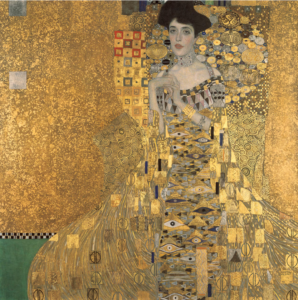
The beauty of Adele Bloch-Bauer’s blushed gaze in Gustav Klimt’s gold-flecked Portrait of Adele Bloch-Bauer I, often referred to as the Woman in Gold, reveals nothing of the tumultuous provenance of the painting.
Adele Bauer was born in Vienna in 1881. Her father was a wealthy banker and railway director, and Adele lived a privileged life.[14] She married Ferdinand Bloch, who was 17 years her senior, in 1899. Both Adele and Ferdinand were passionate about art, and they spent their lives collecting and commissioning paintings.[15] Gustav Klimt painted his first portrait of Adele when she was 22 years old. There is speculation that, while Adele posed as the subject for Klimt’s painting, the two became lovers.[16]
Ferdinand Bloch, a wealthy sugar industrialist, commissioned the golden painting for his wife because of Klimt’s reputation as a renowned artist in Vienna. This was the first of two portraits Klimt would paint for the Bloch-Bauers.[17] Klimt painted the Woman in Gold during his “Golden Phase”—a period of his artistic career marked by his prominent use of gold and gold leaf.[18] The portrait depicts Adele adorned in lavish jewelry and a golden gown. Her cheeks are flushed, and she gazes at the viewer “with both vulnerability and pride.”[19] Adding to her vulnerability is Klimt’s choice to depict accurately a deformity of Adele’s: her malformed hand, which Klimt painted distortedly clasping the other. This is a noteworthy artistic choice because Adele tended to conceal that hand when sitting for portraits.[20]
Klimt was a symbolist, and his use of allegory and mythology to depict feminine symbols paired with gold leaf in the Woman in Gold adds to the exceptional nature of the portrait. Adele’s gown and the background behind her contain figures of triangles, eyes, and eggs—primarily Egyptian symbols that project ideals of femininity, fertility, and beauty.[21]
Maria Altmann and Her Family’s Story
Adele’s and Ferdinand’s niece, Maria Viktoria Bloch-Bauer (Maria Altmann after her marriage) was born on February 18, 1916, in Vienna, Austria, to affluent Jewish parents Gustav Bloch-Bauer and Therese Bauer.[22] Her extended wealthy was close to the artists of the Vienna Secession movement, which Klimt helped establish in 1897.[23] Maria developed close relationships with her Aunt Adele and Uncle Ferdinand during her childhood and often visited their grand house, adorned with artwork, porcelain, tapestries, and elegant furniture.[24] Maria was too young to remember Klimt’s visits to her aunt and uncle, but she frequently saw the six paintings Ferdinand commissioned from Klimt, including the Woman in Gold.
In 1925, Adele developed meningitis and died at the age of 43.[25] Maria recounted that after Adele’s death, the Bloch-Bauer family would take a moment every Sunday to view the golden painting of her aunt.[26] To Maria, the portrait of her aunt was not a masterpiece made for the public eye, but part of a personal collection that her aunt and uncle had thoughtfully curated. Adele’s premature death meant she never lived to see Hitler’s war.
When the Nazis annexed Austria in 1938, Ferdinand fled to escape Nazi control, forced to leave everything, including the six Klimt paintings, to be plundered by the Nazis.[27] Maria had recently married Fritz Altmann, and Ferdinand had attended their wedding. Ferdinand gave Maria the diamond earrings and necklace that Adele had worn for Portrait of Adele Bloch-Bauer I.
Maria, her husband, and her parents did not escape Austria before its annexation and soon thereafter, the Nazis raided Maria’s home. Hermann Göring was involved in the plunder of the Bloch-Bauer family’s riches, and the diamond necklace that Ferdinand had given to Maria ended up on the neck of Göring’s wife.[28] Maria’s father, Gustav, a talented cellist, was forced to watch the Nazis take his precious Stradivarius cello. Maria recalled, “My father died two weeks after that. He died of a broken heart.”[29] The family’s entire art collection, including their Klimt paintings, was seized by the Nazis and taken elsewhere to be stored for the remainder of World War II.[30] They were left with nothing but memories of their prized possessions.
Maria and her family lived under house arrest until they devised a plan of escape. They managed to elude the guards by claiming that Fritz required a dentist. The couple fled upon leaving the house and managed to board a plane to Cologne, Germany, and then traveled to the Dutch border, where they were guided into the Netherlands and ultimately to the United States. The Altmanns ended up in California, where they remained for the rest of their lives.[31]
What happened to the Portrait of Adele Bloch-Bauer I and the other priceless Klimt paintings? It would take more than 50 years, a trial in front of the United States Supreme Court, and a settlement in Austrian court to expose the true story and rightful ownership of the Bloch-Bauer family’s collection of Klimts.
The Restitution of the Painting
After World War II ended in 1945, the Woman in Gold, along with the five other Klimt paintings owned by the Bloch-Bauer family, surfaced in an Austrian federal art museum called the Galerie Belvedere.[32] The Galerie Belvedere resisted restitution, and the Austrian government claimed that the paintings had been willingly given to the museum, in part because the Woman in Gold had become so deeply rooted in Austrian culture—even referred to as the “Mona Lisa of Austria.”[33]
By 1998, the year that Maria Altmann commenced her legal efforts to reclaim her family’s stolen paintings, Post-Cold-War revelations and international public opinion had begun to push nations towards further addressing the issue of art displacement by reason of Nazi plunder.[34] This was the same year that 44 countries, including Austria, signed the Washington Principles on Nazi-Confiscated Art, which served to develop a “just and fair solution” for victims of Nazi plunder and persecution.[35] Prior international efforts to protect and return displaced artworks to their rightful owners were weak, and the odds of restitution had been “crushingly low for so long.”[36] But by the end of the twentieth century, a new generational attitude toward art restitution emerged. The generational shift meant people were “less interested in covering up historical sins” and more determined to expose the ways in which governments, museums, buyers, and dealers had systematically thwarted attempts at repatriating looted art in their possession.[37]
The Woman in Gold hung in the Galerie Belvedere for decades after its confiscation by the Nazis, and Austria laid claim to the painting, insisting that Adele had bequeathed the portrait to Austria in her will.[38] Ownership records conflicted with Austria’s claim, as they showed that the artwork had belonged to Ferdinand and was not Adele’s to give. What Adele wrote in her will was not legally binding, but rather a request that her husband donate the Klimt paintings to the Galerie Belvedere. “The language was framed as a request and was referred to as ‘not binding’ because [Bloch] had paid for the paintings.”[39]
Ferdinand was unable to fulfill his wife’s request because he was forced to flee Vienna in 1939. Six years later, he died impoverished in Switzerland, but not before writing a will of his own.[40] The existence of the will was revealed in a series of investigative articles published in the Austrian press. With the help of investigative journalist Hubertus Czernin, Maria Altmann was able to prove that Ferdinand had named her as one of his heirs. In his will, Ferdinand left his entire estate, including Klimt’s portraits, to his nephews and nieces, who included Maria.[41]
Maria Altmann formally requested restitution of six Klimt paintings under Austrian restitution law: Portrait of Adele Bloch-Bauer I, Portrait of Adele Bloch-Bauer II, Apfelbaum I, Buchenwald, Häuser in Unterach am Attersee, and Amalie Zuckerkandl.[42] The request was rejected in 1999 by the Austrian Restitution Committee.[43] Altmann challenged the decision before Austrian courts, but ultimately withdrew that claim because of the costly legal fees required by Austrian law (1.2% of the litigated value, so, in this case, around $1.6 million).[44]
Altmann met 32-year-old lawyer, E. Randol Schoenberg (fittingly also of Austrian heritage, and grandson of Austrian composer Arnold Schoenberg), through his grandmother.[45] Schoenberg was working at the law firm of Fried, Frank, Harris, Shriver & Jacobson until 2000, when, at age 33, married with one child and a second on the way, he quit his job to devote his full attention to Altmann’s case.[46] With Schoenberg as her counsel, Altmann sued the Republic of Austria and the Galerie Belvedere in the Central District of California, alleging expropriation of property in violation of international law.[47] Altmann claimed ownership of the paintings under Ferdinand’s Will and alleged that the Galerie Belvedere obtained possession of the paintings through wrongful conduct in the years during and after World War II.[48] For eight years, Schoenberg worked tirelessly on a case that many believed to be futile. “Literally, no one thought I had a chance of winning,” said Schoenberg.[49]
The Republic of Austria and the Galerie Belvedere, as defendants, filed a motion to dismiss Altmann’s complaint, asserting, among other defenses, a claim of sovereign immunity. The Foreign Sovereign Immunities Act of 1976 (FSIA) permits suit against a foreign nation where the case involves “rights to property taken in violation of international law.”[50] Austria, however, claimed that the FSIA did not apply to this case because the paintings had been taken in the 1940s, long before the FSIA’s enactment, when the United States embraced a more extensive idea of sovereign immunity that would have barred the suit.[51] The FSIA’s text did not explicitly state that it retroactively applied to actions taken before it was passed, so Austria argued that it was entitled to the pre-FSIA, broader definition of immunity. The District Court sided with Altmann, “holding that the FSIA applied retroactively,” and the Court of Appeals for the Ninth Circuit affirmed.[52] Austria appealed, and the Supreme Court of the United States (SCOTUS) granted certiorari to answer the question of whether the Foreign Sovereign Immunities Act of 1976 applies to claims that are based on conduct that occurred before the FSIA’s enactment.[53]
In a 6-to-3 decision written by Supreme Court Justice John Paul Stevens, SCOTUS ruled that, while the FSIA does not explicitly state that it should be applied to actions that took place before its passage, there are strong indications in the text of the statute that, “Congress intended the Act to apply to preenactment conduct.”[54] Justice Stevens wrote that, the FSIA itself provides that claims of foreign states to immunity “are ‘henceforth’ to be decided by the courts, . . .” which clearly shows, continued Stevens, that “. . . Congress intended courts to resolve all such claims ‘in conformity with [FSIA] principles’ regardless of when the underlying conduct occurred.”[55] So, despite the odds being against Altmann and Schoenberg, the duo prevailed. In 2006, eight years into Altmann’s fight for the restitution of her family’s paintings, SCOTUS cleared the way for her to sue the Austrian government.[56]
Austria delayed bringing the case to trial, and Altman “feared that the Austrian government was just waiting for her to die.”[57] The parties ultimately turned to binding arbitration, within which it was decided that five of the six paintings that the Nazis had stolen from Altmann’s family would be returned to her.[58]
The surprising success of Altmann and Schoenberg rippled through the art and legal worlds. Following her victory, Altmann’s advisors pressured her to create competition between auction houses to obtain the best possible selling price for the recovered works. Altmann was not interested in their advice, as primary goal in pursuing the restitution of her family’s stolen artwork had never been financial. Altmann simply wanted justice for her family. She sold her newly-acquired Klimt paintings, save for the Woman in Gold, at Christie’s auction house in November 2006 and donated the majority of the proceeds—$192 million dollars—to relatives and charities.[59] The proceeds from the sales were used in part to establish the Maria Altmann Family Foundation, which supports the Los Angeles Museum of the Holocaust and other philanthropic institutions.[60] Schoenberg’s victory as Altmann’s lawyer forged the beginnings of his distinguished career in art law.[61]
The Woman in Gold Today
Maria Altmann chose to sell her paintings through Christie’s auction house because she trusted Stephen Lash, the Chairman Emeritus of Christie’s, who had offered her support throughout her legal battle with the Austrian government. “What I remember was her total lack of self-interest and total lack of greed,” Lash said.[62] Once Altmann had reclaimed and gained possession of her paintings, Lash introduced her to Ronald Lauder—art collector, gallery owner, and heir to the Estée Lauder fortune.[63] Lauder purchased the 1907 Portrait of Adele Bloch-Bauer I shortly thereafter, in a private sale aided by Christie’s, for $135 million dollars. At the time of the sale, the selling price for the painting was the highest ever paid for an artwork.[64] Lauder acquired the painting for his Neue Galerie, in New York City’s Upper East Side, where it remains on view for the public to date.[65]
Altmann’s election to sell her newly restituted artworks through Christie’s drew a strong public response. Many criticized Altmann for “falling prey to the temptations of the art market.”[66] Others saw the value in the attention the case brought to issues of ownership and restitution.
Conclusion
The story of Altmann’s recovery of the Woman in Gold is unique in its success but should not obscure a common underlying tragedy. The painting was never meant to symbolize Austrian nationalism. Instead, the Portrait of Adele Bloch-Bauer I should be remembered as a symbol of all that was taken from the Bloch-Bauer family. Its restitution offers just one example of the loss caused by Nazi plunder of art.
Though the world will never fully recover from the displacement of art and cultural property that took place during World War II, we have a duty to educate ourselves on the immeasurable damage done, honor those whose lives and welfare were taken from them, and address the displacement of art that largely still exists.
The unfortunate fact remains that restitution tends to be more of an exception than a rule. Austria was not alone in declining to return Nazi-plundered art after World War II. In France, for example, fewer than 100 of the 2,000 unclaimed looted artworks hanging in museums have been returned.[67] Attempts to recover stolen art regularly result in failure, and successful claims are typically backed by money, resources, detailed records, and luck.
Despite the relative rarity of a success story like Altmann’s, publicizing her triumph is tremendously important. Altmann’s case can be used to set precedent for and inspire others. As Schoenberg stated in an interview, “Each time there’s a success, it gives people more hope, and that allows the restitution efforts to continue.”[68] Success breeds hope. One restitution motivates other claimants to persist in their own fights. These cases also place pressure on countries and international organizations to establish new mechanisms and legal infrastructures for seeking out provenance, recovering pieces, and returning them to their rightful owners. One winning case will spark another. And another.
[1] Sarah Pruitt, When Hitler Tried (and Failed) to Be an Artist, History, (Sep. 13, 2019) https://www.history.com/articles/adolf-hitler-artist-paintings-vienna.
[2] Sarah Pruitt, supra note 1; United States Holocaust Memorial Museum, Washington DC, Adolf Hitler: Early Years, 1889–1921, Holocaust Encyclopedia (Mar. 25, 2025), https://encyclopedia.ushmm.org/content/en/article/adolf-hitler-early-years-1889-1921#:~:text=Hitler%20in%20Munich%2C%201913%E2%80%931914,selling%20his%20watercolors%20and%20sketches..
[3] Sarah Pruitt, supra note 1.
[4] Id.
[5] Lynn H. Nicholas, World War II and the displacement of art and cultural property, The Spoils of War – World War II and its aftermath: the loss, reappearance, and recovery of cultural property (1997), 39 (Paper presented at international symposium, The Spoils of War, sponsored by Bard Graduate Center for Studies in the Decorative Arts, New York, January 1995).
[6] How Hitler and the Nazis defamed art, German News Service (Feb. 11, 2017), https://www.dw.com/overlay/media/en/how-hitler-and-the-nazis-defamed-art/41174698/41204445#:~:text=Modern%20artworks%20whose%20style%2C%20artist,the%20original%20exhibition%20in%20Munich..
[7] Livius Drusus, How the Mona Lisa Escaped Destruction during World War II, Mentalfloss (Aug. 25, 2016), https://www.mentalfloss.com/article/84865/how-mona-lisa-escaped-destruction-during-world-war-ii.
[8] Benjamin Sutton, Victory of Samothrace Is Back on View at the Louvre, artnet (Jul. 9, 2014), https://news.artnet.com/art-world/emvictory-of-samothraceem-is-back-on-view-at-the-louvre-57888.
[9] Livius Drusus, supra note 7.
[10] Id.
[11] Ernest Latham, Conducting Research at the National Archives into Art Looting, Recovery, and Restitution, National Archives (Aug. 15, 2016), https://www.archives.gov/research/holocaust/articles-and-papers/symposium-papers/conducting-research-art-looting.html#:~:text=In%20times%20of%20war%20it,the%20removal%20of%20these%20objects..
[12] Anne Rothfeld, Nazi Looted Art: The Holocaust Records Preservation Project, National Archives, Summer 2002, Vol. 34, No. 2, https://www.archives.gov/publications/prologue/2002/summer/nazi-looted-art-1#nt12.
[13] The story of Gustav Klimt’s Adele Bloch-Bauer, the woman in gold, Christie’s (Jan. 6, 2025), https://www.christies.com/en/stories/gustav-klimts-woman-in-gold-af6b7e85385e46248b911d4f5533cfde.
[14] Elana Shapira, Adele Bloch-Bauer, Jewish Women’s Archive (Jun. 23, 2021), https://jwa.org/encyclopedia/article/bloch-bauer-adele.
[15] Id.
[16] The story of Gustav Klimt’s Adele Bloch-Bauer, the woman in gold, supra note 13.
[17] Elana Shapira, supra note 14.
[18] Kimberly Bradley, The mysterious muse of Gustav Klimt, BBC News (Sep. 20, 2016), https://www.bbc.com/culture/article/20160920-who-was-the-woman-in-gold.
[19] Id.
[20] Id.
[21] Kimberly Bradley, supra note 18; Elana Shapira, supra note 14; Catherine McHugh, Maria Altmann: The Real Story Behind ‘Woman in Gold’, Biography.com (Sep. 30, 2020), https://www.biography.com/authors-writers/woman-in-gold-maria-altmann-biography.
[22] Catherine McHugh, supra note 21.
[23] Id.
[24] Id.
[25] The story of Gustav Klimt’s Adele Bloch-Bauer, the woman in gold, supra note 13.
[26] Catherine McHugh, supra note 21.
[27] Nina Totenberg, After Nazi Plunder, A Quest To Bring Home The ‘Woman In Gold’, NPR (Apr. 2, 2015), https://www.npr.org/2015/04/02/396688350/after-nazi-plunder-a-quest-to-bring-the-woman-in-gold-home.
[28] Catherine McHugh, supra note 21.
[29] Id.
[30] Id.
[31] Id.
[32] Gustav Klimt: Five Paintings From the Collection of Ferdinand and Adele Bloch-Bauer, Exhibition: Jul 13 — Oct 9, 2006, Neue Galerie (accessed Feb. 12, 2026), https://www.neuegalerie.org/exhibitions/klimt-paintings-bauer-collection.
[33] The story of Gustav Klimt’s Adele Bloch-Bauer, the woman in gold, supra note 13.
[34] Patricia Cohen, The Story Behind ‘Woman in Gold’: Nazi Art Thieves and One Painting’s Return, New York Times (Mar. 30, 2015), https://www.nytimes.com/2015/03/31/arts/design/the-story-behind-woman-in-gold-nazi-art-thieves-and-one-paintings-return.html.
[35] Patricia Cohen, supra note 34; Washington Principles on Nazi-Confiscated Art (1998), [Released in connection with The Washington Conference on Holocaust Era Assets, Washington, DC, December 3, 1998] https://www.state.gov/washington-conference-principles-on-nazi-confiscated-art.
[36] Patricia Cohen, supra note 34.
[37] Id.
[38] Nina Totenberg, supra note 27.
[39] Id.
[40] Id.
[41] Id.
[42] Caroline Renold, Alessandro Chechi, Anne Laure Bandle, Marc-André Renold, Six Klimt paintings – Maria Altmann and Austria, Platform ArThemis, Art-Law Centre, University of Geneva (accessed Feb. 13, 2026), https://plone.unige.ch/art-adr/cases-affaires/6-klimt-paintings-2013-maria-altmann-and-austria.
[43] Id.
[44] Id.
[45] Nell Minow, Interview: The Woman in Gold’s Simon Curtis and E. Randol Schoenberg, Movie Mom (Mar. 31, 2015), https://moviemom.com/interview-the-woman-in-golds-simon-curtis-and-e-randol-schoenberg/. “. . . she was very close with my family, very close with my grandmother and she would tell stories about my grandmother and great grandmother.”
[46] E. Randol Schoenberg ’88 Profile, Princeton University Alumni Council (2009), https://www.princeton.edu/~alco/CTNAT/2009/schoenberg.html; Kevin Lang, Woman in Gold: History vs. Hollywood, History vs. Hollywood (May 7, 2015), https://www.historyvshollywood.com/reelfaces/woman-in-gold/.
[47] Caroline Renold, et al., supra note 42.
[48] Republic of Austria v. Altman, 541 U.S. 677 (2004).
[49] E. Randol Schoenberg ’88 Profile, supra note 46.
[50] Republic of Austria v. Altman, 541 U.S. 677 (2004); Republic of Austria v. Altmann, Oyez, https://www.oyez.org/cases/2003/03-13 (last visited Feb 26, 2026).
[51] Republic of Austria v. Altmann, Oyez, https://www.oyez.org/cases/2003/03-13 (last visited Feb 26, 2026).
[52] The District Court denied the motion, 142 F. Supp. 2d 1187 (CD Cal. 2001), and the Court of Appeals affirmed, 317 F. 3d 954 (CA9 2002), as amended, 327 F. 3d 1246 (2003); Republic of Austria v. Altmann, Oyez, https://www.oyez.org/cases/2003/03-13 (last visited Feb 26, 2026).
[53] Republic of Austria v. Altman, 541 U.S. 677 (2004).
[54] Id.
[55] Id. As the District Court observed, (citing 142 F. Supp. 2d 1187, 1201 (CD Cal. 2001)), this language suggests Congress intended courts to resolve all such claims “in conformity with the principles set forth” in the Act, regardless of when the underlying conduct occurred.
[56] Patricia Cohen, supra note 34.
[57] Nina Totenberg, supra note 27.
[58] Patricia Cohen, supra note 34.
[59] Nina Totenberg, supra note 27.
[60] Maria Altmann, Wikipedia (accessed Feb. 13, 2026), https://en.wikipedia.org/wiki/Maria_Altmann; Maria Altmann Family Foundation, ProPublica (accessed Feb. 13, 2026), https://projects.propublica.org/nonprofits/organizations/274739650.
[61] E. Randol Schoenberg, Burris, Schoenberg & Walden, LLP (accessed Feb. 13, 2026), https://www.bslaw.net/schoenberg.html.
[62] The story of Gustav Klimt’s Adele Bloch-Bauer, the woman in gold, supra note 13.
[63] The Woman in Gold, Neue Galerie (accessed Feb. 13, 2026), https://www.neuegalerie.org/womaningold; The story of Gustav Klimt’s Adele Bloch-Bauer, the woman in gold, Christie’s (Jan. 6, 2025), https://www.christies.com/en/stories/gustav-klimts-woman-in-gold-af6b7e85385e46248b911d4f5533cfde.
[64] The story of Gustav Klimt’s Adele Bloch-Bauer, the woman in gold, Christie’s (Jan. 6, 2025), https://www.christies.com/en/stories/gustav-klimts-woman-in-gold-af6b7e85385e46248b911d4f5533cfde.
[65] The Woman in Gold, supra note 63.
[66] Zachary Pincus-Roth, Return of a Treasure, Princeton Alumni Weekly (Jan. 21, 2016), https://paw.princeton.edu/article/return-treasure.
[67] Patricia Cohen, supra note 34.
[68] Id.