By Tess A. Toland, Esq. April 16, 2026
A step into Gallery 899 at The Metropolitan Museum of Art presently renders one face-to-face with a black-chalk Portrait of a Young Boy (ca. 1500) by Raphael. In this reputed self-portrait, the artist steadily watches his viewer, bidding them well on their journey through the extensive and exquisitely curated retrospective by Carmen C. Bambach—Marica F. and Jan T. Vilcek Curator of Drawings and Prints at The Met.
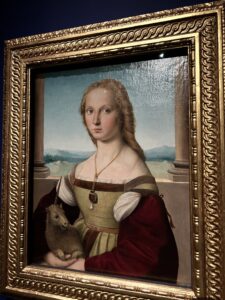
YOUNG WOMAN WITH UNICORN BY RAPHAEL AT THE METROPOLITAN MUSEUM OF ART | PHOTOGRAPH COURTESY OF TESS A. TOLAND
To the right of the black-chalk portrait is a list of the Lenders to the Exhibition—sixty-one to be exact. The works that make up this retrospective were borrowed from lenders in Austria, France, Germany, Hungary, Italy, Vatican City, Netherlands, Spain, Sweden, Switzerland, the United Kingdom, and the United States.
Early on the well-delineated path through the exhibition are drawings and paintings by Raphael’s father, Giovanni Santi. Raphael received his earliest training from his father.[1] Santi was both a painter and a writer, best known for his epic poem about an Italian general, scholar, and art patron.[2] Witness to his son’s artistic gifts, Santi brought Raphael to study with the artist Pietro Perugino at a young age.[3] Perugino’s artworks lead visitors deeper into the exhibition gallery.
Curator Bambach toyed with anticipation by teeing up works by Santi, Perugino, and other influences of Raphael before presenting us with Raphael’s second work in the exhibition: Processional Banner of the Confraternity of the Santissima Trinità, Città di Castello (ca. 1497–99)—a processional banner featuring the protector saints Sebastian and Roch on the obverse side, and the creation of Eve on the reverse. This was Raphael’s first independent commission, and could be the artwork that earned him the title of magister (master) by 1500.[4]
A litany of works by Raphael follows, including an entire room dedicated to Raphael’s depictions of the Virgin and Child. This room, remarks Isabella Rossellini—the official narrator of Raphael: Sublime Poetry’s audio guide—is a reminder of the high mortality of mothers and children during the High Renaissance. Raphael himself lost his mother to childbirth when he was eight years old.[5] These paintings carry hidden undertones in the context of Raphael’s life because the Madonna and Child was often commissioned for people to put in their homes after they gave birth.
Raphael: Sublime Poetry is saturated with more artistry than the mind can absorb in one walk-through. Look at the accuracy with which Raphael paints eyes in his Portrait of Bindo Altoviti (ca. 1515-16). And are those sketches by Leonardo da Vinci?[6] Watch the members of Raphael’s workshop meticulously imitate his approach and style in The Madonna del Divino Amore altarpiece (ca. 1516-18). What is this mid-2nd century Roman sarcophagus fragment doing here?[7] See how Raphael designed in other mediums, such as for The Sistine Tapestries, commissioned by Pope Leo X to be hung in the Sistine Chapel at special occasions.[8]
A retrospective of this scale and with this level of international participation is accomplished through rigorous organization, cooperation, planning, trust, and—of course—contracts. Museums, galleries, and collectors interested in lending or borrowing art must consult counsel to ensure that proper legal protections are in place.
The central legal document involved in an exhibition such as Raphael: Sublime Poetry is an Art Loan Agreement. An art loan agreement is a contract that outlines the terms and conditions of lending and borrowing an artwork or collection.[9] Clear drafting is essential for protection of the artwork(s) involved, and to safeguard parties’ interests. Key to a collector’s proper use of bargaining power is the understanding that, in the context of an art loan, collectors are in the superior position to demand contractual language that protects their interests.[10] The Art Museum of the Americas (AMA) offers sample Incoming Art Loan Contract and Outgoing Art Loan Contract templates, though these are skewed in favor of museums over collectors.[11] The following is a list of items that art loan agreements typically, and should, cover:
- Artwork description, identification, condition, and value;
- Loan period and termination and extension rules;
- Responsibilities and indemnity;
- Limits on liability;
- Insurance;
- Transportation (packing, courier, shipping, and return obligations);
- Condition report(s);
- Venue and display requirements;
- Conservation requirements;
- Repair and restoration rights;
- Intellectual property, reproduction, publicity, and credit line language;
- Change of ownership;
- Force majeure clause;
- Sale clause (clarifying work is not offered for sale);
- Donation clause (clarifying work is not being donated); and
- Dispute resolution and choice of law.[12]
When a loan is international, the Immunity from Judicial Seizure statute comes into play. The U.S. Department of State administers the Immunity from Judicial Seizure statute (22 U.S.C. § 2459), which protects art and cultural objects imported into the U.S. for temporary exhibition from seizure.[13] For objects being loaned internationally, lenders often require the borrower to apply for and obtain this protection before shipment. 22 U.S.C. § 2459(a) states, in relevant part:
“Whenever any work of art or other object of cultural significance is imported into the United States from any foreign country, pursuant to an agreement entered into between the foreign owner . . . and the United States or one or more cultural or educational institutions within the United States providing for the temporary exhibition or display thereof within the United States . . . , no court . . . may issue or enforce any judicial process, or enter any judgment, decree, or order, for the purpose or having the effect of depriving such institution . . . of custody or control of such object if before the importation of such object the President or his designee has determined that such object is of cultural significance and that the temporary exhibition or display thereof within the United States is in the national interest, and a notice to that effect has been published in the Federal Register.”
The Immunity from Judicial Seizure Application Procedure Checklist can be found here.
Often handled alongside an art loan agreement involving international shipment are transport and customs documents.[14] Guidance on the specific paperwork needed for international fine art shipping can be found here. Other considerations and add-ons in the context of international loans include insurance certificates evidencing “nail-to-nail” coverage, which means insurance coverage is in place from the moment the art is taken off the owner’s wall, until it returns to its original location.[15]
This breakdown of the contracts behind Raphael: Sublime Poetry is provided for informational purposes only and does not constitute legal advice. The content herein is not intended to create, and receipt of it does not establish, an attorney-client relationship. If you are considering entering into an Art Loan Agreement or similar contract, please contact this firm or another qualified professional for guidance tailored to your specific circumstances.
[1] Raphael: Sublime Poetry Exhibition Text, The Metropolitan Museum of Art (accessed Apr. 13, 2026), https://www.metmuseum.org/exhibitions/raphael-sublime-poetry.
[2] Id.
[3] Id.
[4] Id.
[5] Isabella Rossellini Audio Guide, Raphael: Sublime Poetry, The Metropolitan Museum of Art (accessed Apr. 21, 2026), https://www.metmuseum.org/exhibitions/raphael-sublime-poetry/audio-guide.
[6] Raphael: Sublime Poetry Exhibition Text, supra note 1. “On his arrival in Florence in 1504, Raphael’s approach to the design process changed drastically, especially once he understood the potential in Leonardo’s theories about spontaneous sketching. Leonardo may have invited Raphael to study his drawings, which would have shown him examples of a diversity of techniques and media.”
[7] Raphael: Sublime Poetry Exhibition Text, supra note 1. “Raphael created a more dynamic composition for the Baglioni Altarpiece after looking at marble reliefs from ancient Roman sarcophagi.”
[8] Raphael: Sublime Poetry Exhibition Text, supra note 1. “The imperious Pope Leo X charged Raphael with the daunting task of designing a set of monumental tapestries to hang in the Sistine Chapel during special occasions—a project that put Raphael in direct competition with Michelangelo and his ceiling frescoes above.”
[9] The Art Loan Agreement: Examples for Small Institutions, Conserv (Jan. 24, 2024), https://conserv.io/blog/the-art-loan-agreement-examples-for-small-institutions/.
[10] Lending art and collectibles to museums, PWM Merrill Lynch (Feb. 13, 2026), https://www.pbig.ml.com/articles/lending-art-and-collectibles-to-museums.html.
[11] Art Loan Contract, Art Museum of the Americas (AMA) (accessed Apr. 21, 2026), https://museum.oas.org/img/forms/loanoutgoing.pdf.
[12] The Art Loan Agreement: Examples for Small Institutions, supra note 9; Lending art and collectibles to museums, supra note 10.
[13] Immunity from Judicial Seizure Applications – Cultural Objects, U.S. Department of State (accessed Apr, 21, 2026), https://2009-2017.state.gov/s/l/c3432.htm.
[14] Shipping Art Internationally: Customs, Regulations, and Documentation, Diversified Transportation Services (accessed Apr. 21, 2026), https://www.dtsone.com/shipping-art-internationally-customs-regulations-and-documentation/.
[15] Alicia B. Thomas, Fine Arts Services, Appraising & Consulting, Nail-to-Nail, LLC (accessed Apr. 21, 2026), https://nailtonail.com/#:~:text=%E2%80%9CNail%2Dto%2DNail%E2%80%9D%20is%20terminology%20used%20in,returns%20to%20its%20original%20location..